
A while ago, I wrote a paper on the importance of image schemas in the Assassin’s Creed franchise. This article highlights some important takeaways.
Image schemas are connected to experiencing our everyday world. We need them to structure and connect meanings. Think of image schemas as a network or spider’s web, where you have many dots connected by webs.
FORCE schemas are the most salient ones to this medium because they affect player’s experience incredibly and they mark both the narrative and ludic progress.
What has this to do with games? Well, games are supposed to give players experiences. Both AC titles do that. However, one is more successful than the other, because one has a better execution of image schemas, in particular FORCE (don’t worry, I’m not yelling at you, this is how schemas are being written) schemas. This means, schemas are important for making games experiencable!
The FORCE schema is your typical physical force schema. Here’s a list of these schemas found in Unity and Origins:
These are the common physical force schemas found in both games, with ATTRACTION being the most direct one: ATTRACTION, COMPULSION, BLOCKAGE, COUNTERFORCE & REMOVAL OF RESTRAINT, and DIVERSION. The only FORCE schema that cannot be found either in Unity nor in Origins is ENABLEMENT. ENABLEMENT is a not actualized, potential FORCE path that is mainly found in multiplayer games that include real player interactions, such as Destiny (Activision, 2014). In contrast to the non-playable characters (NPC) in Unity, real players represent external, potential forces that can be used to achieve a goal.
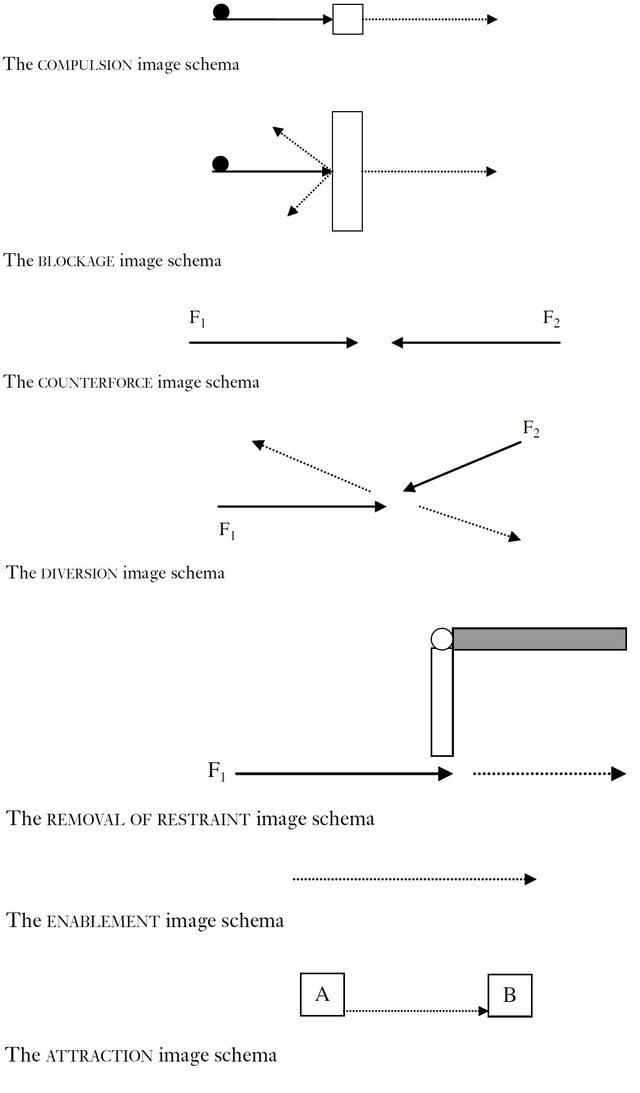
Figure above: Johnson’s Seven Most Common Physical Forces taken from Evans & Green (2006: 188-189).
It seems that both games utilize almost all FORCE schemas, so what’s the problem with these games? Short answer: quantity over quality.
Hear me out:
The amount of the used FORCE schemas is irrelevant if they do not interact with each other and do not work towards completing the game’s journey. Unity suffers from this and especially from defect or broken schemas which leave a negative effect on players, while Origins thrives in using the same schemas to create unique player experiences. In short: know your forces.
In Unity, the existing FORCE schemas are just there hanging in the air. Not only are they not coherent and don’t support play experiences, but their importance for the
objective of the game on the global context is not taken seriously. This makes it hard for player to reach the goal of the game, when they can’t express FORCE schemas in the game (mechanics and actions do not have the desired outcome and restrict players freedom). Origins on the other hand creates smooth play experiences, because the FORCE schemas work as they are supposed to. Origins is basically the opposite of Unity.
In summary, FORCE schemas are at the core of every qualitative play experience.
It is necessary to be aware of the powers they have over a game’s & player’s journey and they need to be used wisely to enable every player a smooth gameplay.
I recommend to read the whole paper, as this article clearly isn’t going into any details. You can find it here, for free, forever: On the Importance of FORCE Schemas in Video Games – A Linguistic Analysis of the Assassin’s Creed Franchise
 Playful Brain Demand