

After 7 years of development Naughty Dog finally released its much anticipated sequel – The Last of Us Part II – on June, 19th 2020. To my surprise, I managed not to watch any materials related to the game’s progress and marketing because I wanted to have a true play experience. So far I played approximately 5 hours and made a stop at the FEDRA Gate. The game did surprise me quite a bit but I’m not going to write about that today. Today I’m reviewing the game on it’s usability. This is a GUR (games user research) review.
So far The Last of Us Part II made me cry very early on. Mostly because of its story but also because of few unnecessary usability problems. The biggest problem so far is that the game accepts only its linear solutions. Let me explain how
- forced problem solutions,
- linearity cuts the rope, and
- light brings clarity
are destroying the game quality.
Forced problem solutions

As you are cleaning up the infected on your patrol mission, you need to find an entrance to a building. The only way you can reach it is by climbing up a truck. You see that pile of snow in the picture placed exactly next to the truck? Why not use the newly introduced jumping mechanics and use the environment to climb up the truck? No. Or what about climbing up the part between the truck front and back? It’s exactly the height that I need to reach the top? No. The game wants you to climb up the front of the truck and use the jumping mechanics to jump between the front and back. Why? I don’t know. It felt awkward that I found other ways of solving a problem which were much more convenient and logical but they weren’t accepted as such.
Solution to this problem could have been to see how often this instance occurs, then either change the objective or the environment surrounding the truck (i.e. take away the options) or allow all or few possible options a player can take. This gives your players a much higher rewarding system. Especially, when your game is linear.
Linearity cuts the rope
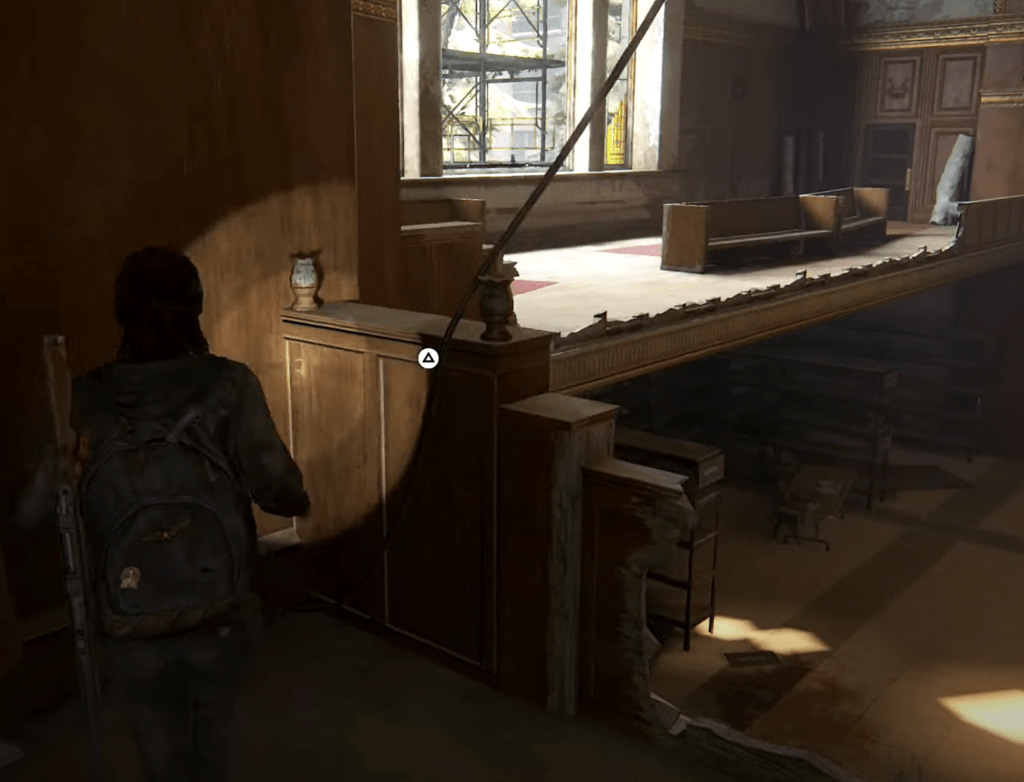
Upon exiting one of the first buildings you’ll be discovering in Seattle, there’s a rope that you want to use to reach the other balcony. I used the rope by pressing the triangle and then noticed a door on that same platform. Naturally, I went back. Which was a good decision as Dina told an interesting story about herself. Then I went back to get the same rope only to find it hanging out there in the room. Well, that’s unfortunate but I should still be able to reach it, it’s only a jump away. Of course that didn’t work. Unfortunately, the only solution to that problem was restarting the sequence.
First of all, this problem feels like a bug. Still, the UX could have suggested a solution here. For instance, if the player decided to go back, and if the rope isn’t approachable from the balcony, then let the player jump on the rope. Offer your player multiple solutions when they are reasonable to account for issues. You will always have bugs and there’s probably nothing you can do about it. But you can contain lots of usability problems by extending your knowledge and user expectations and offering more than one valid solution.
Light brings clarity
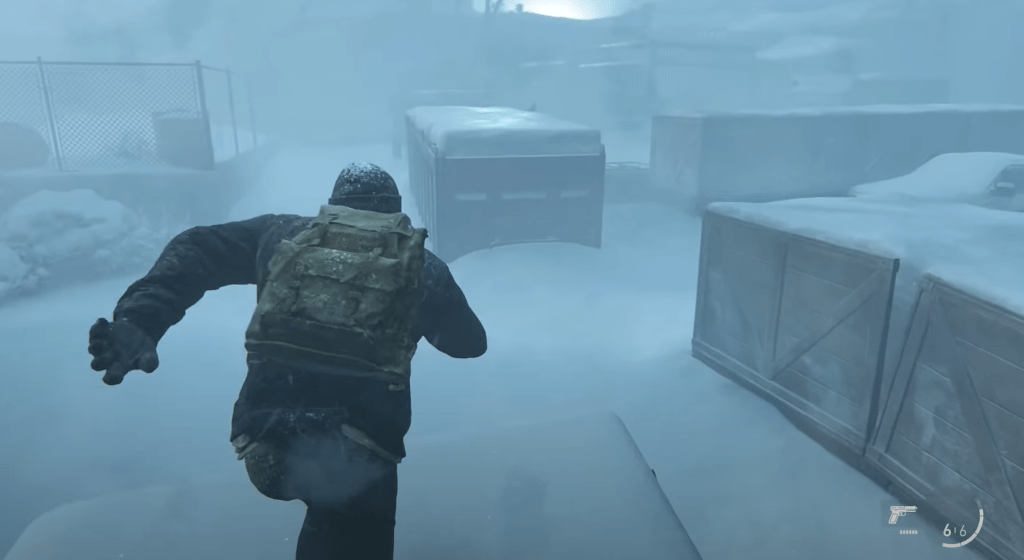
As you’re running away from a large horde of enemies, you (as the gamer-youtuber TheRadBrad) might find yourself lost. You can hear the infected tracking your every step but all you want to do is find an exit. On the screenshot above you can see it, as it is clearly highlighted. But as you’re playing, you are not looking above or for a light source. You’re not used to it. Naughty Dog games have taught you to look for yellow markings in the world you’re navigating. Yet, all you see is white snow. Eventually, after running around or restarting again, you will realize there has to be something to progress and you will jump up that fence you’ve been searching for all along.
You may ask yourself, ‘well you got your exit, so what’s the big deal about it?’ Yes, the objective is complete but it didn’t represent an optimal play experience. A game should strive to create the best possible experience for a player. That’s what game development is all about. Having your players losing time and feeling frustrated with such simple tasks is unnecessary because we as GURs can do better. Don’t be lazy and rush through smaller scenes. Smaller scenes can and will add up to the overall experience.
The Last of Us Part II is a great example how even larger studios shouldn’t just rely on influencer’s or game critic’s feedback. Yes, it might be valuable in terms of helping sell your game more but it’s not going to help you with unbiased play experiences. Devil’s in the details, something simple playtesting and GUR can help with. Dear Naughty Dog, your players are cleverer that you think, let them solve your puzzles in their own way whenever applicable, consider adding other bug/problem solutions that a player can solve right away without having to restart the sequence, mark the road more clearly, and most importantly trust your playtesters!
What is your experience with The Last of Us Part II so far? Did you encounter any other issues that bothered you? What are your thoughts on golfing?
 Playful Brain Demand